Thursday, 15 November 2012

What are my chances to successfully get a position in USA?

Is it possible? What are my chances of getting in? Is all this money and effort going to be worth it? Can I finally be a doctor in the US?

These were the questions I used to ask myself everyday when I was thinking of taking the USMLE, and even while I was studying for the USMLE steps.

It is a difficult question. I can only try to answer you using some statistics.

The above data shows the number of positions offered by each specialty, and how many of it is taken up by U.S. medical graduates. Lets discuss a few common specialties which most of us Malaysians are interested in.

Internal Medicine
If you look at internal medicine, there are about 5,000 positions offered, and the U.S. graduates only take up 55.7% percent of these positions. This means that about 2,000 (40%) foreign medical graduates managed to get a position in Internal Medicine in 2012.

General Surgery
There are a total of 1,100 positions being offered for categorical (5-year program) and 1,200 for preliminary (1-year program where you need to re-apply the following year). Out of these, foreign medical graduates take up about 200 (20%) categorical spots and 700 (60%) preliminary spots.

So it seems that there are quite a number of positions taken up by foreign medical graduates in the U.S. Now lets take a look at what does statistics tell us about "chances".

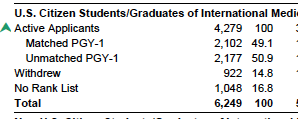
Looking at the data, we can see that the chances of matching is about 40%. To simply put it, about half of those who applied will be successful, and half won't.

Now the big question is : What are the factors which determines who gets a position and who doesn't?

After I completed my USMLE steps, I started preparing for the "Match" - which is the process whereby one gets "matched" into a residency position. This involves submitting my scores, my CV and other various documents, flying to the U.S. for interviews, and finally ranking the programs which I liked (and having the programs rank me as well).

I also bought a couple of books about this "Match" process. Based on my research, the top 2 reasons which are important for the program directors (people who will hire you) when they look at a foreign grad are :

No. 1) USMLE Scores
No. 2) English proficiency during interview

No doubt there are other smaller factors as well, but the above are the top 2. I am not surprised by the 1st factor. USMLE scores is the only way these program directors can objectively judge your knowledge level. However, I was initially quite taken aback by "English proficiency". My reasoning was : if one can pass the USMLE steps, shouldn't they already possess adequate "English"?

Only during my trip to the U.S. for interviews did I understand why. In some of the programs which I interviewed at, there were a lot of other foreign graduates as well. They come from India, Middle East, China and various other countries, and they can be really hard to be understood. Their writing is excellent, but when it comes to speaking, we Malaysians have a huge advantage. We are lucky that we communicate to each other a lot in English. We should also be thankful that our ward rounds and patient notes are all in English. The most frequent comment I received while I was interviewing was "Wow, you can speak really good English!" - and that was even while I was speaking in our normal Malaysian accent.

So actually, the biggest hurdle is one's USMLE scores. If you score poorly, it is going to be really difficult to get a position. I spent a lot of time to come up with a solid study plan and study materials for myself. I am also thankful that I studied hard for the USMLEs. All my sacrifices paid off in the end.

There is no short cut to get to the U.S. for residency training. You need to put in your time and effort, and make sacrifices in terms of your leisure time. One thing about the U.S. as long as you are willing to work hard, nothing will stop you from getting what you want. Not even race or nationality. In fact, let me show you one last data.
5% of US medical graduates and 50% of Americans who trained outside of USA don't get matched (means they don't get a spot).

You may be thinking, "What? But they are American citizens! Why didn't they get a spot?"
The answer is because, program directors want the best, regardless of ones citizenship. Their spot were taken by stronger applicants, who are foreign medical graduates. It is not about your citizenship, whether you are a "European Union citizen" like in the UK, or whether you have a "Permanent Resident status" like in Australia. This is America, the land of immigrants and opportunities. Program directors hire the strongest applicants, regardless of their citizenship status.

The final question is : Can you be the one that they are looking for?

- Jamie -
Tags : what are my chances, working as doctor in USA, residency, specialization in USA, doctor, USMLE, Kuala Lumpur, Malaysia

Thursday, 18 October 2012

What is "Residency"?

When you start your journey as a doctor in the U.S., you will start as a "resident". When you complete your "Residency" which is about 3-5 years, you are regarded as a "specialist". You can work as an independent specialist, and can choose to stay in an academic setting (generally means university hospitals) or go to private practice.
In order to help you understand better, allow me to use the analogy of Grey's Anatomy.

As you can see here. This is the ranking system in the hospital. When you apply for a residency position, you need to determine which specialty you would want to train for. In the case of Meredith Grey, she decided to pursue a residency in General Surgery. Immediately upon graduation from medical school, she enters a general surgery residency. She has few big bosses, who are her Attendings. The biggest boss is the Chief of Surgery. She also has a small boss, who is the Chief Resident. The Chief Resident is a 5th year surgical resident. Meredith Grey will become a Chief Resident 4 years later, and she will become an Attending 5 years later. She may stay on to work as an Attending and perhaps one day she will get to become the Chief of Surgery.

In order to put this into a Malaysian perspective, here is what the ranking system will be like if we use our terms into Seattle Grace Hospital.
A few questions which may be in your mind right now:

Question: What about housemanship in the U.S.?
In the U.S. system, there is no housemanship when you graduate (and no compulsory service as well). They have the "Residency" system. Singapore is currently also adopting a similar system. There is also no "medical officer" or "compulsory service". Upon graduation, you enter into a training program in your field of choice. That training program is known as "RESIDENCY". The duration of a residency program ranges from 3 to 5 years, depending on the specialty. General surgery is 5 years. Internal medicine and Pediatrics is 3 years.

Question: Isn't the intern = houseman?
No. The intern is a first year resident. For example in a general surgery residency, interns (or 1st year residents) train only in the surgical department. The last time Meredith Grey delivered a baby was in medical school during her OBGYN rotation. There are certain residency programs like ophtalmology which requires the 1st year resident to rotate in the medical department for 1 year before entering ophtalmology.

Question: What happens immediately after you complete residency?
There are a two general pathways:
  • Work as an Attending
    • If you complete ENT residency, you work as an ENT surgeon. You can choose to work in a few settings
      • Academic: which are places with residents. Here, your job is not only to provide service to patients, but also to teach residents and medical students. A good comparison would be a specialist working in University Malaya Medical Center.
      • Private: where it is mainly providing service to patients. But of course this is where the money is. A good comparison would be a specialist working in Gleneagles. However, you lose the satisfaction of teaching and mentoring, unlike if you remain in the academic setting.
  •  Continue with a Fellowship (subspecialization)
    • Fellowships is where one goes after completing residency. If Christina Yang completes general surgery residency, she can opt to continue her training to subspecialize in cardiothoracic surgery. If one completes a pediatric residency, one can opt to continue with a fellowship in pediatric nephrology.
    • If you are interested in a fellowship, you will need to apply for it in your final year as a resident. If you get a spot for fellowship, you will begin fellowship training immediately after completion of residency training.
The reason I used "Masters trainee" instead of medical officer or housemanship, is because I can't find an equivalent term for a resident in the U.S. Another equal term may be "Postgraduate trainee" or "Registrar".

 I hope I have outlined the general pathways well. These are the things which I was not clear about before I embarked on my USMLE journey, and in the same way others have enlightened me, I hope I make it clear to you as well.

- Jamie -
Tags : what is residency, work as doctor in usa, USMLE, Kuala Lumpur, Malaysia, kuala lumpur, specialization

Thursday, 20 September 2012

What is the USMLE?

This post is to provide some basic information about the USMLE.

The United States Medical Licensing Exam is an exam taken in order to be licensed to practice as a doctor in the US.

It consist of three steps (with 2 separate parts in Step 2):
a) USMLE Step 1 - with basic science questions (anatomy, biochemistry etc)
b) USMLE Step 2 Clinical Knowledge (CK)- with questions on diagnosis and management (psychiatry, surgery etc)
c) USMLE Step 2 Clinical Skills (CS) - which aims to tests your interaction with patients
d) USMLE Step 3 - which focuses more on the management of patients

You only need Step 1, Step 2 CK and Step 2 CS in order to be certified by the Education Commission of Foreign Medical Graduates (ECFMG). Step 3 is not required to get a residency training position in the U.S., and therefore, most people usually only take it one year after they start working. In my subsequent posts, I will just ignore this Step 3. The most important steps are your Step 1, Step 2 CK, and Step 2 CS.

The USMLE Steps can be taken in any order. Many clinical students choose to take the Step 2 CK first because clinical knowledge is most fresh in their mind.

Question: Where can I sit for the USMLE exams?
You can sit for the Step 1 and Step 2 CK exams in Kuala Lumpur. The Step 2 CS needs to be taken in the US.

Question: When can I sit for the USMLE exams?
Anytime! The USMLE exams is a computer based exam. It runs every week throughout the whole year, except for the first two weeks in January. You just need to register for the exam, and book a spot in the Kuala Lumpur Prometric Center. You will be taking your test in a cubicle with a computer. There will be people in other cubicles taking various other examinations, such as the TOEFL. You can sit for the exam even while you are a medical student, or even if you are a 60-year-old doctor.

Question: So, once I complete the USMLEs, I can work in the US?
Unfortunately no. The first thing to understand is that there are a lot of other foreign graduates (non-US doctors) who are applying for a position in the US. These people come from India, Phillipines, Pakistan and so on. Hence, in order to compete for a spot, the USMLE is no longer just about "completion". What you score matters heavily. Generally, scores are reported in a 3-digit scale (the 2-digit scale is not the most important). Average score is around 220. In order to be a competitive applicant, you need to score above the average.

Question: Once I am done with the USMLEs, what's next?
Once you completed Step 1, Step 2 CK and Step 2 CS, you can apply for a residency position in the U.S. This is a three to five year training program. You can apply in whichever specialty training program you wish, ranging from General Surgery to Psychiatry. The competitiveness of the programs depend on its field (Neurosurgery vs Pediatrics), its location (urban vs rural), the hospital (university hospitals vs community hospitals) and so on. Application opens on September 15th every year, and during November to January, you will then head for interviews at various programs in different hospitals. By March 15th, you will get to know whether you got a position or not, and if you got a position, you will also know which hospital you will be working at. By July 1st every year, residents begin their first day at work.

Question: How do I score well in the USMLE?
"The general who wins the battle makes many calculations before the battle is fought". The first step is to make a study plan, get the right USMLE books and study materials. You can do this by doing your own research at various USMLE forums. Popular forums include prep4usmle.com and usmle-forums.com. I did a couple of weeks of research to come up with the best study plan and study materials for myself.

- Jamie -

Do you have any other questions? Feel free to write under the comment section or just email me. I will try to help if I can.

Tags : USMLE, Kuala Lumpur, Malaysia, What is, USMLE Books, to be a doctor in USA